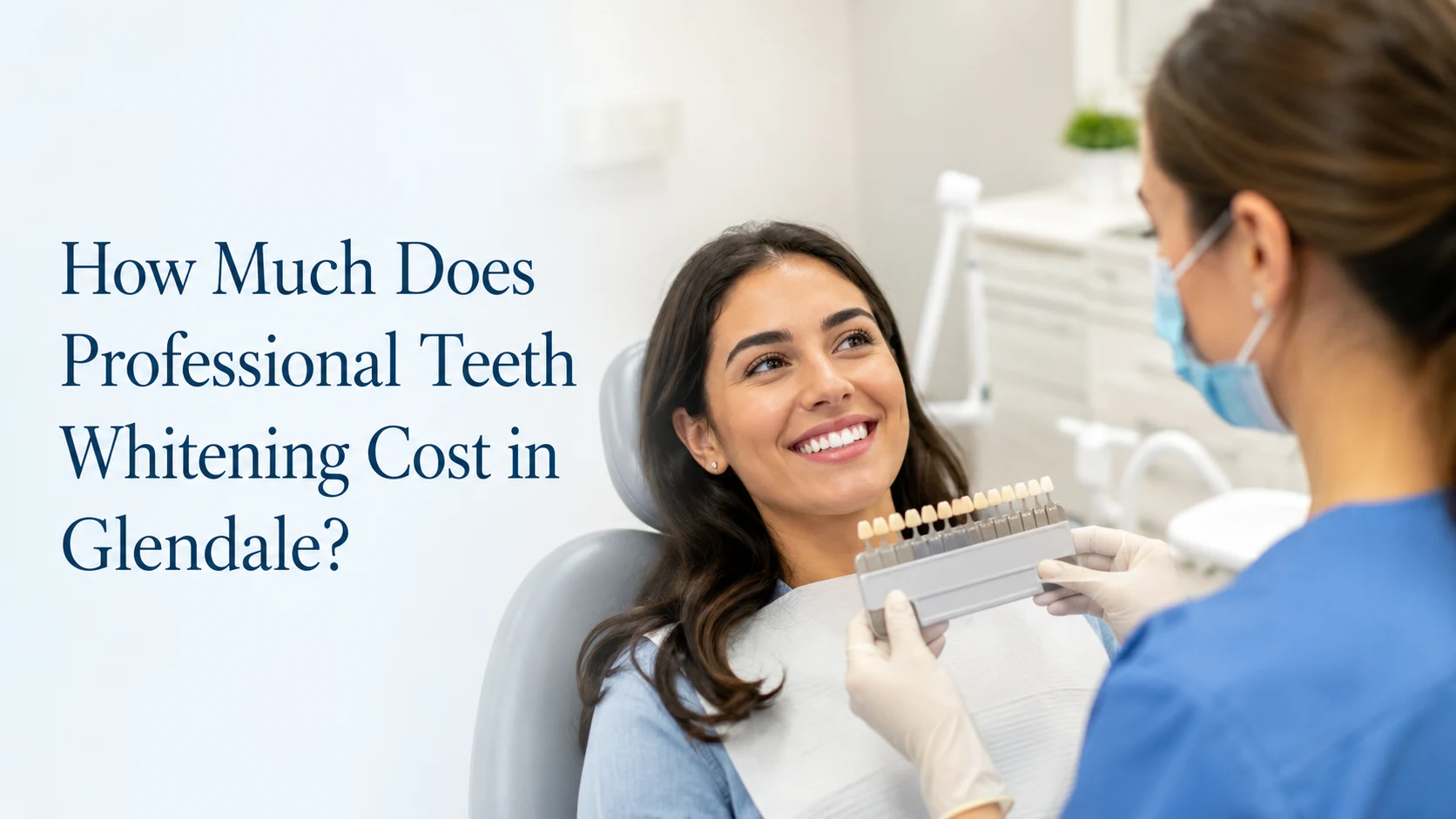
If you’re considering professional teeth whitening, the price is probably one of the first things you want to understand. In Glendale, whitening costs can vary based on the treatment type, whether you need any dental care beforehand, and how much whitening you want to achieve.
For many patients, professional in-office whitening costs about $300 to $600 per session. However, the advertised whitening price may not match what you end up paying.
An exam, cleaning, additional whitening session, or take-home maintenance products can change the final cost.
This guide focuses specifically on what goes into the cost of teeth whitening, so you can estimate your likely budget before comparing treatment options.
Quick Answer: What Does Teeth Whitening Cost in Glendale?
A reasonable starting budget for professional in-office whitening is approximately $300 to $600.
The actual cost can be lower or higher depending on factors such as:
- The whitening method being used
- The severity of your tooth discoloration
- Whether you need one or several applications
- Whether an exam or cleaning is required first
- Whether custom take-home trays are included
- Whether you purchase maintenance or touch-up products afterward
That is why two patients receiving “teeth whitening” may get different quotes, even from the same dental office.
When comparing a Denist Glendale provider, look beyond the advertised price and check what’s actually included in the treatment.
Teeth Whitening Cost by Treatment Type
There is more than one way to whiten teeth, and the method you choose has one of the biggest effects on cost.
| Whitening option | Relative cost | Treatment time | Best suited for |
| Store-bought strips | Lowest | Several days or weeks | Mild staining and smaller budgets |
| Dentist-supervised take-home trays | Moderate | Several days | Patients who prefer whitening at home |
| In-office professional whitening | Higher | Usually around one appointment | Patients wanting faster results |
| In-office treatment plus take-home maintenance | Higher | Office visit plus home use | Patients wanting initial whitening and future touch-ups |
The least expensive option isn’t necessarily the one that provides the fastest or most noticeable change.
Store-Bought Whitening Products
Whitening strips, gels, and similar over-the-counter products usually cost substantially less than professional treatment.
The tradeoff is that they generally use a different treatment approach and produce more gradual results.
They can make sense for mild surface staining or for someone primarily concerned about cost.
Dentist-Supervised Take-Home Whitening
Professional take-home whitening typically involves trays designed to fit your teeth and whitening gel supplied by a dental professional.
Instead of completing the process in one appointment, you use the trays at home according to the recommended schedule.
This option offers a middle ground between inexpensive store-bought products and full in-office treatment.
In-Office Whitening
In-office whitening costs more because a dental professional performs and monitors the treatment.
Your gums and other soft tissues are protected before a stronger whitening product is applied.
Depending on the whitening system, the product may be applied more than once during the same appointment.
If you’re comparing options mainly because you want a noticeable result quickly, the additional cost of in-office treatment may be worth it.
Why Can One Whitening Quote Be More Expensive Than Another?
The whitening treatment itself is only one part of the potential cost.
Several other factors can affect your total.
1. Your Starting Tooth Shade
Someone with mild surface staining may need less treatment than someone with significant or longstanding discoloration.
Coffee, tea, tobacco, aging, medications, and other factors can also create different types of staining.
Not every type of discoloration responds to whitening in exactly the same way.
2. Whether You Need a Dental Exam First
A dental professional generally needs to make sure your teeth and gums are healthy enough for whitening.
Untreated cavities, gum problems, significant sensitivity, or other dental concerns may need attention before a professional recommends cosmetic whitening.
If the advertised whitening price doesn’t include an exam, your total cost may increase.
3. Whether You Need a Cleaning
Whitening gel changes tooth color, but it doesn’t replace a professional cleaning.
If plaque, tartar, or significant surface staining is present, a cleaning may be recommended separately.
When comparing quotes, ask whether a cleaning is:
- Included
- Required separately
- Recommended but optional
This can prevent an low advertised price from turning into a noticeably larger bill.
4. The Number of Whitening Sessions
Some people are satisfied after one treatment.
Others may want additional whitening or may have discoloration that requires a different approach.
An important budgeting question is therefore:
Is the quoted price for one session or for the entire recommended whitening plan?
That distinction can matter more than a small difference between two advertised prices.
5. Take-Home Products
Some whitening packages include custom trays, extra whitening gel, or another product for future touch-ups.
Others charge for these separately.
A higher initial quote may therefore represent better value if it includes products you would otherwise purchase later.
What Should Be Included in a Teeth Whitening Quote?
Before comparing prices, ask for an itemized explanation of the treatment.
At minimum, find out whether the quoted price includes:
- Initial dental evaluation
- Whitening treatment
- All applications performed during that appointment
- Protective materials used during treatment
- Any required follow-up visit
- Take-home whitening trays
- Additional whitening gel
- Post-treatment sensitivity products
- Future touch-ups
This makes it much easier to compare two quotes fairly.
For example, a lower-cost quote that includes only the whitening procedure may ultimately cost more than a package that includes the exam and take-home maintenance.
A Better Way to Budget for Whitening
Instead of asking only, “How much is teeth whitening?” it can be more useful to think about three possible cost situations.
Scenario 1: Straightforward Whitening
Your teeth and gums are healthy, you recently had a cleaning, and you only need one whitening appointment.
In this situation, your cost may stay relatively close to the advertised treatment price.
Scenario 2: Whitening Plus Preventive Care
You want your teeth whitened but need an examination or cleaning beforehand.
Your overall expense will include those services in addition to whitening unless they are bundled together.
Scenario 3: Whitening Plus Maintenance
You complete an in-office treatment and also want trays or whitening gel for future touch-ups.
This costs more initially but may reduce how often you feel the need to repeat a complete in-office whitening session.
Thinking about your likely scenario gives you a more realistic budget than comparing treatment advertisements alone.
When Paying More for Whitening May Make Sense
A higher price does not automatically mean better treatment.
Likewise, the cheapest offer is not automatically the best value.
It may be reasonable to pay more when the price includes something useful, such as:
- An examination before treatment
- Custom take-home trays
- Additional whitening applications
- Sensitivity management
- Follow-up care
- Maintenance gel
What matters is understanding why the treatment costs more.
If two offices quote very different amounts for what appears to be the same procedure, ask each one exactly what is included before comparing them.
Will Dental Insurance Pay for Teeth Whitening?
Teeth whitening is generally considered a cosmetic treatment, so dental insurance usually does not pay for the whitening procedure itself.
That does not necessarily mean every service surrounding your whitening treatment will be handled the same way.
For example, an examination or cleaning may be separate from the cosmetic procedure.
Coverage varies by plan, so check with your insurer and dental office rather than assuming the entire visit will or will not be covered.
How Long Do Whitening Results Last?
The original brightness does not last permanently.
Whitening results may remain noticeable for roughly six months to two years, although the actual duration varies considerably from person to person.
Habits that can cause staining to return more quickly include frequent consumption of:
- Coffee
- Tea
- Red wine
- Dark-colored foods and beverages
- Tobacco products
Regular brushing, flossing, dental cleanings, and occasional whitening touch-ups can help maintain the appearance for longer.
When calculating the long-term cost of whitening, consider maintenance costs.
Will Whitening Work on Crowns, Veneers, or Bonding?
This is an important question because not every visible tooth surface responds to whitening.
Whitening products are intended to change the appearance of natural tooth structure.
Existing restorations such as:
- Crowns
- Veneers
- Tooth-colored fillings
- Dental bonding
do not whiten in the same way natural teeth do.
If you have restorations in visible areas, changing the shade of your natural teeth could create a difference between the two.
That is one reason an evaluation before whitening can be useful.
When Teeth Whitening May Not Be the Right Solution
Not every dark or discolored tooth requires stronger whitening.
Some discoloration is deeper within the tooth and may not respond as predictably as ordinary surface staining.
In other situations, the appearance a patient wants may require a different cosmetic treatment rather than repeated whitening sessions.
This matters from a cost perspective.
Paying for multiple whitening treatments that are unlikely to correct the underlying discoloration can be more expensive than identifying the problem first.
Questions to Ask Before Paying for Whitening
When you receive a quote, consider asking:
- Is this price for one treatment or the complete recommended treatment?
- Is an examination included?
- Do I need a cleaning before whitening?
- Are take-home trays included?
- Will I need to purchase additional whitening gel?
- What happens if I am not satisfied after the first session?
- Is there an additional charge for a follow-up treatment?
- How should I maintain the result?
- Will existing fillings, crowns, or veneers affect the final appearance?
These questions usually tell you more about the true cost than the advertised number alone.
Final Thoughts
Professional teeth whitening Glendale typically costs around $300 to $600, but your final price can vary depending on what your treatment includes. An exam, cleaning, extra applications, or take-home products can all affect the total.
Compare the full cost of each option, not just the advertised price. Knowing what’s included upfront can help you avoid surprises and choose the right treatment for your budget.
Frequently Asked Questions
How much does professional teeth whitening cost in Glendale?
The current advertised rate is $300 to $600 for in-office professional teeth whitening. The prices and offers can change, so confirm before booking.
Does dental insurance cover teeth whitening?
Typically, no. Teeth whitening is a cosmetic procedure, so dental insurance may not cover it.
How long does an in-office whitening appointment take?
The treatment takes about one hour.
How many shades whiter can my teeth become?
Results differ for every person. Your starting tooth color and type of stains can affect the results.
Does professional teeth whitening hurt?
Some people may have temporary tooth sensitivity or gum irritation. Your dentist can help out just to lessen these effects.
Can crowns, fillings or veneers be whitened?
No. Whitening works on natural teeth and doesn’t whiten crowns, veneers or most fillings.
Should I have my teeth cleaned before whitening?
A cleaning may help eliminate plaque and surface stains. Your dentist can tell you whether you need a cleaning first.
How soon before a wedding should I whiten my teeth?
Many people choose to whiten shortly before an event. Ask your dentist about the best timing.